
Cost-per-foot is the number everyone asks for and the least useful one. Here is what actually moves the price, and what a comparable quote should contain.
The first question on most conveyor enquiries is cost per foot. It is an understandable question and a nearly useless one, because two quotes at the same price per foot can differ by a factor of two in what they actually deliver.
Here is what moves the number, and what a quote needs to contain before you can compare it to another one.
What actually drives the price
Material and finish
Mild steel powder coated versus stainless is the single biggest swing on many jobs. Washdown construction (continuous welds, no lap joints, drainable framework, tool-free belt removal) costs more to fabricate than a painted mild steel frame, for good reasons.
Controls
A conveyor with a single fixed-speed drive and a conveyor with zoned control, variable frequency drives, PLC and HMI are different products. Controls scope is where quotes diverge most and where the line item is often vaguest.
Duty and environment
Washdown, ambient temperature, product weight and running hours all feed into bearing, motor and frame selection. A conveyor specified for dry case handling and one specified for daily caustic washdown are not comparable even if the dimensions match.
Complexity per foot
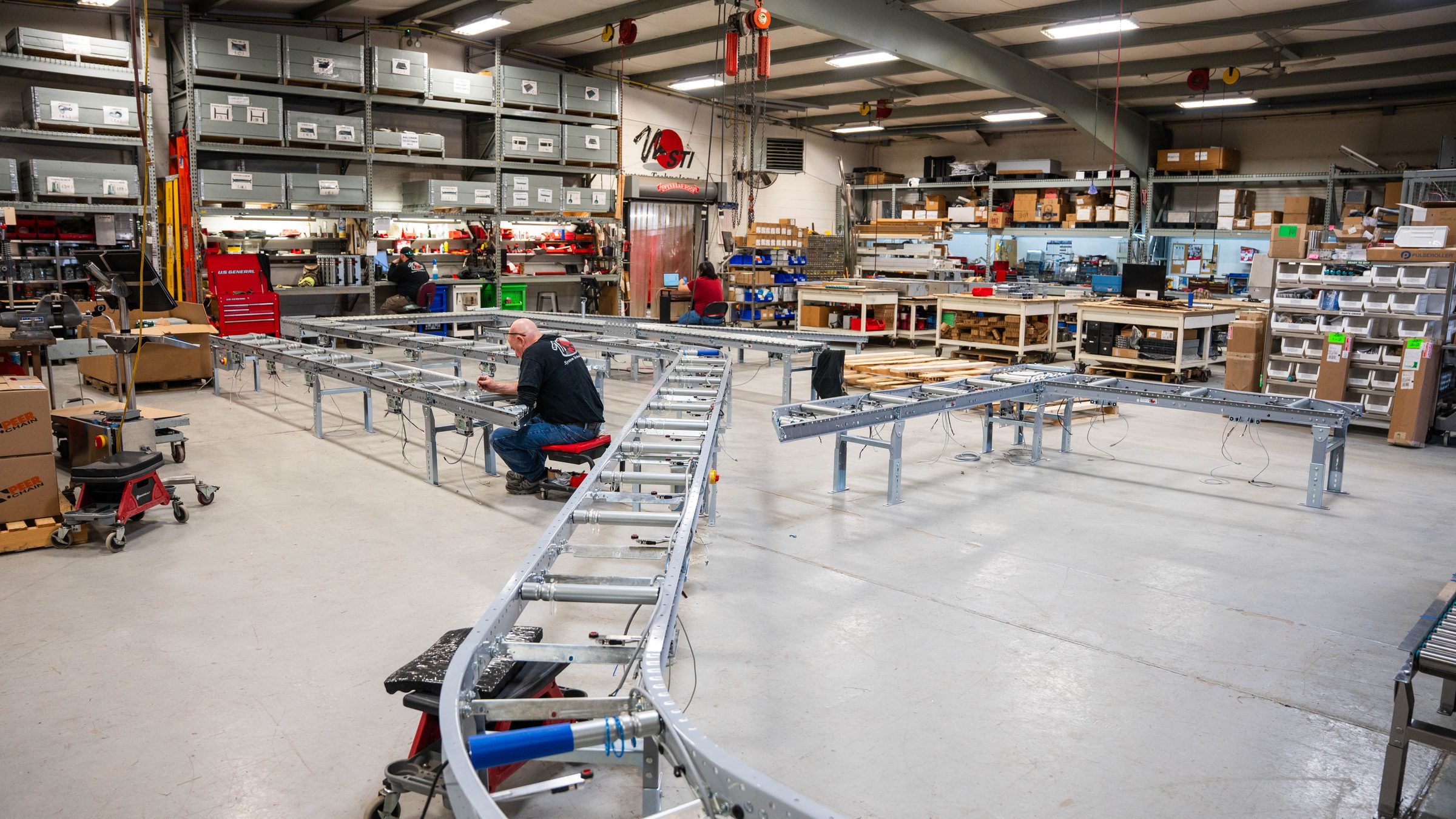
Straight runs are cheap. Curves, transfers, merges, elevation changes and accumulation zones are not. A hundred feet of straight slider bed and a hundred feet containing two right-angle transfers and a merge are different jobs.
Integration scope
Whether the conveyor has to talk to machines it did not come with (and who is responsible when it does not) is frequently the largest hidden cost in a project.
What belongs in a comparable quote
If you are putting a line out to bid, ask every bidder to break out the same items. Differences become visible immediately:
- Mechanical scope by section, with material and finish stated
- Controls scope: panel, drives, PLC/HMI programming, and who owns the code
- Guarding and safety devices, and to which standard
- Short-circuit current rating of the control panel
- Installation: who performs it, how many trips, and what site conditions are assumed
- Startup and commissioning, and what "complete" means
- Training and documentation: manuals, drawings, bill of materials
- Spare parts recommended at handover
- Freight and rigging
- What is explicitly excluded
That last line is the most informative one on any quote.
The exclusions that become change orders
The items most often left out, and most often argued about later:
- Electrical drops to the equipment: frequently assumed to be the customer's scope without saying so
- Compressed air supply
- Floor preparation and anchoring
- Removal of existing equipment
- Integration with a machine supplied by someone else
- Work outside normal hours, if the plant cannot give up production time

Why single-source usually reads cheaper over the project
When mechanical, panel build, programming and installation sit with different vendors, the gaps between them are where schedule and budget go. Nobody quotes the gap, but somebody pays for it.
That is an argument for clear scope boundaries more than for any particular vendor, but it is the main reason integrated quotes and component quotes are hard to compare on price alone.
Ask for the assumptions, not just the number
A quote is a set of assumptions with a price attached. The assumptions are the part worth reading: what rate, what product, what environment, what the site provides, what happens if the product changes next year.
System Technology quotes mechanical, controls, fabrication, installation and startup as one scope, because we do all of it in-house in Joliet. If you want a quote you can genuinely compare against another, ask us to break it out the way described above.